What makes a piece of writing unforgettable? How does it come to move us?
My experience writing in English and translating from Tamil and Spanish suggests an answer that’s as multidimensional as it is simple.
Great writing doesn’t merely convey so-called information. It also partakes of a deeper reality, something much closer to our sinews and bones. A rhythm akin to that of our heart. Patterns of sound that both sing and say.
Or, to put it another way, a music of meaning able to make our hearts and minds sing and dance together.
Cutting Through the Noise
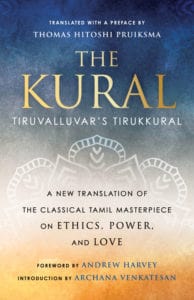
For example, in the fourth chapter of the Kural, there’s a verse that condenses the book’s entire philosophy of meaningful action into less than two lines of poetry:
In the original Tamil, the poet Tiruvalluvar makes use of a steady, stately rhythm, a two-part structure, and a pattern of rhyming consonants and vowels to make his meaning and meanings come alive.
These are the same qualities I’ve attempted to bring into my English translation, to the extent that my abilities and the language have allowed it. Read the verse out loud and listen, for instance, to the N sounds in “mind,” “nothing,” and “noise,” or the T sounds in “right,” “purity,” and “heart.”
These and other qualities hint at the ways Tiruvalluvar is able to touch our lives with his words.
For the sound of the Tamil, you can have a listen here:
Rooted Intelligence
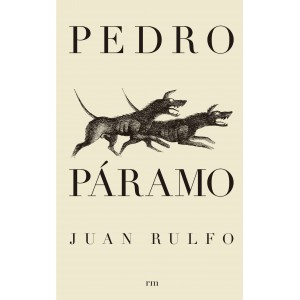
Here’s another example from the other side of the world. In Juan Rulfo’s novel Pedro Páramo, Juan Preciado, son of Pedro Páramo, enters the house of a woman named Eduvijes Dyada, who has offered him a place to stay for the night.
As he follows her through the increasingly dark house, he sees bulks and bundles growing at their sides. “What is it that’s here?” he asks. And she answers:
In the English translation, I’ve attempted to convey some of the musical quality of the original, which I think you can sense even if you don’t know any Spanish:
Try reading the words out loud and see if you notice the T sounds in “Tiliches,” “Tengo,” “toda,” and “entilichada,” or the rhyming A sounds in ella, casa, toda, and (again) entilichada, or the four-part rhythm of the final sentence as a whole.
If you happen to know Spanish, you might also notice the natural eloquence with which this character has taken the unusual word “tiliches,” meaning “stuff” or “things” or “odds and ends,” and transformed it, with a flourish, into a predicate adjective, “entilichada,” something like “stuffed” or “tilichified”:
It’s this playful intelligence, both of Juan Rulfo and his unforgettable characters, that I hope most to convey. In this case I’ve used the alliteration of H sounds, a play on “stuff” and “stuffed,” and a sentence structure that suggests the same basic rhythm:
These subtle but all-encompassing qualities make Rulfo’s novel an unparalleled poem in prose.
What Feeds Us
All of this matters far more than it may at first appear.
When we’re surrounded by increasingly superficial and ephemeral language, intended to be consumed and forgotten the next day, our ears and our hearts-and-minds hunger all the more for something able to nourish us deeply.
Something that helps make our own experience meaningful–as meaningful as a song, or a prayer, or a promise.

Let Freedom Ring
Here’s a third example, one that has continued to resound ever since it first sounded in 1963. During the March on Washington that summer, Dr. Martin Luther King, Jr., not only charged the sentence “I have a dream” with prophetic meaning, but gave us this unforgettable pair of lines:
Say the words out loud and listen. You might hear, among other things, how “children” and “nation” echo each other, and how the words “I have a dream” and “day” come back, renewed, in the second “I have a dream today!”
But what strikes the bell of my heart is the way he uses the C and K sounds in “color,” “skin,” “content,” and “character” to make the truth of his vision sing forth: “not be judged by the color of their skin but by the content of their character.”
The music of meaning isn’t some mere ornament. It isn’t an extra. It’s what returns us to who we are, and what we truly believe.
Natural Eloquence
The next time you’re moved by something someone writes or says, I encourage you to take a moment to notice if part of what has moved you connects to the music of their meaning.
Similarly, if you find that something you yourself have written or said strikes a chord with other people, see if it too connects to the music of your own meaning.
Attending to the qualities of words in these ways can allow them to help us discover and cultivate our own natural eloquence.

Stay In Touch
If you’d like to receive notes like this one in your inbox, sign up for my newsletter.
Together we can explore what Ezra Pound calls “news that STAYS new.”